Table of Contents
- Detox and Addiction Treatment Center in Oklahoma City, Oklahoma: Your Top Questions Answered
- Understanding the Cost and Insurance Coverage for Detox and Addiction Treatment in Oklahoma City
- The Admissions and Treatment Process at an Oklahoma City Detox and Addiction Center
- Accreditations, Licensing, and Facility Standards for Detox Centers in Oklahoma City
- Timeline and Duration of Detox and Addiction Treatment Programs in Oklahoma City
- Aftercare, Ongoing Support, and Specialized Services for Lasting Recovery
- Still Have Questions About Detox and Addiction Treatment in Oklahoma City?
A detox and addiction treatment center in Oklahoma City must deliver medically supervised care that respects your dignity from the first call through aftercare, Royal Life Centers provides that continuity with Joint Commission-accredited, LegitScript-certified programs and 24/7 admissions support. Because we care, we staff our Oklahoma City detox center with a clinical team that includes physicians, licensed therapists, and case managers so every guest receives a personal treatment plan grounded in research-based therapies.
We know families searching for a detox center in Oklahoma City can trust ask urgent questions about safety, therapies, cost, and what daily life looks like during treatment. This page answers the top questions we hear at our facility, from what makes detox centers in OKC different to how insurance works for addiction treatment in Oklahoma City. Our goal is to give you clear, factual information so you can make a confident decision about the next step. We know financial considerations matter, so we break down costs and insurance options in the following content.
Understanding the Cost and Insurance Coverage for Detox and Addiction Treatment in Oklahoma City
The cost of addiction treatment at Royal Life Centers is determined individually based on each guest’s specific clinical needs and the appropriate level of care. We do not publish a fixed price list because no two treatment plans are identical. A guest entering medical detox will have a different cost structure than someone stepping down into a partial hospitalization program (PHP) or an intensive outpatient program (IOP). The length of stay, the frequency of therapeutic services, and the need for medication-assisted treatment all influence the final estimate. Our clinical team conducts a thorough assessment to understand each person’s medical history, substance use, and mental health needs before providing a transparent, no-obligation quote. This custom-quote model ensures that every guest pays only for the services they actually require, whether that involves residential inpatient care, outpatient services, or a combination of levels across our full continuum.
We simplify the insurance verification process for potential clients of our addiction treatment and detox center in Oklahoma City. We accept several of the largest insurance companies including BCBS PA (Independence), BCBS IL, Moda Health, VA VAPCCC Region 4B, Employee Benefit Management Services, and Health Comp. Our 24/7 admissions team provides a free, no-obligation insurance verification. This means our team will contact your insurance company and see if you have active coverage, how much of your deductible is met, and what your out-of-pocket responsibility would be. As a Joint Commission accredited and LegitScript certified facility, we adhere to the highest standards and transparency when it comes to client finances and billing. If a client has a coverage gap or their insurance plan does not fully cover treatment at the level recommended, our team will help the client with financing inquiries and/or explore alternative payment methods without pressure or obligation. Once the financial aspects of treatment are understood, the client can commence the admissions process, which begins with a confidential assessment.
Key Takeaways
- The first call to a treatment center in Oklahoma City begins with a confidential conversation between the individual reaching out and one of our admissions counselors.
- Oklahoma City detox centers must comply with a complex regulatory framework.
- Our levels of care are personalized to the guest and reflect the level of clinical progress being made during that phase of treatment.
- After completing detox and formal treatment, sustaining recovery depends on a structured continuum of care that extends well beyond the initial program.
The Admissions and Treatment Process at an Oklahoma City Detox and Addiction Center
The first call to a treatment center in Oklahoma City begins with a confidential conversation between the individual reaching out and one of our admissions counselors. We listen carefully, gather initial information about what’s been going on, and answer the most pressing questions. Our team answers the phone 24/7, ready to help at the moment someone decides to seek support.
After the phone assessment, we move to immediate insurance verification. Our staff reviews benefits in real time, working with your provider to confirm coverage and explain any out-of-pocket responsibilities clearly. With a clear financial picture, the next step is scheduling your intake at our Oklahoma City facility. We coordinate arrival, handle the clinical assessment on site, and complete paperwork.
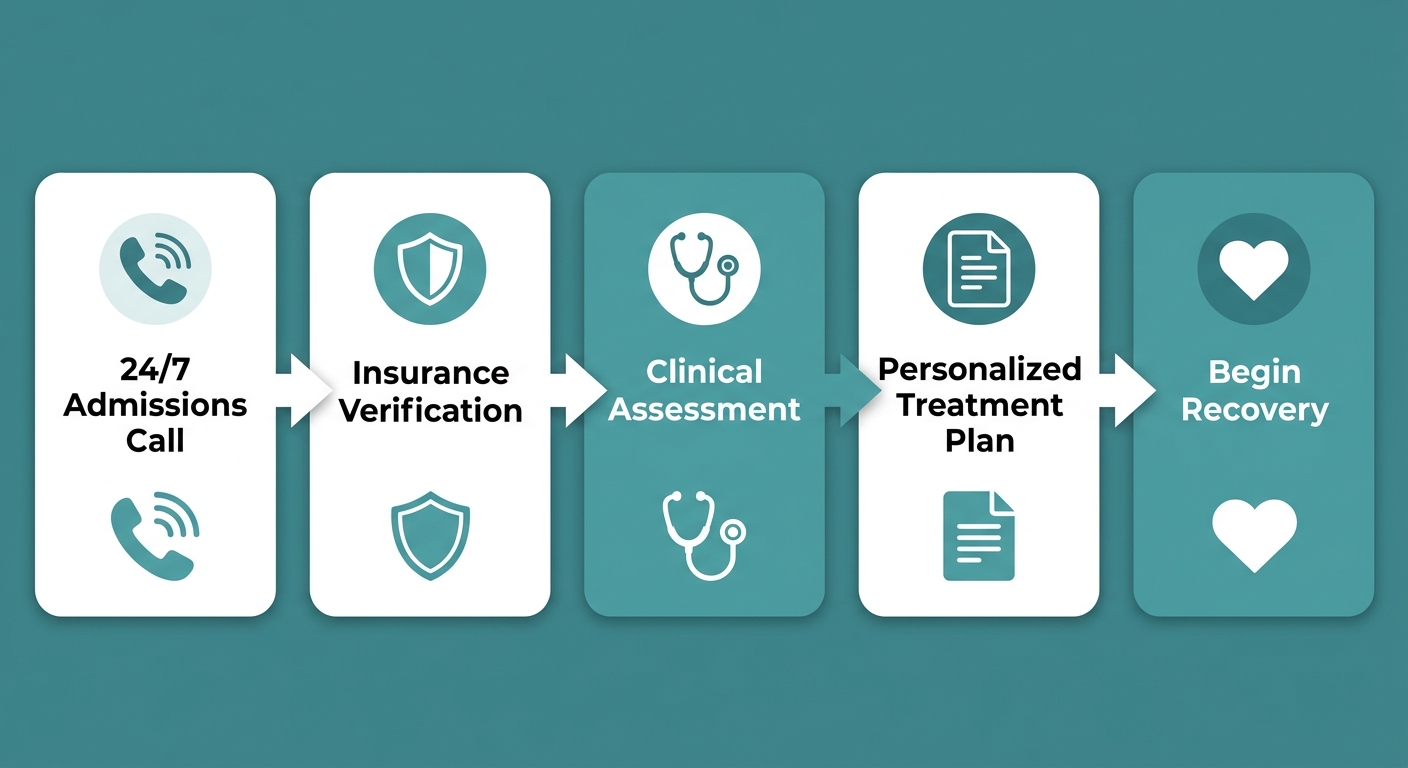
The transition into active care follows a structured, predictable format. Medically supervised detox is available first for guests who need it, with our clinical team monitoring vital signs and managing withdrawal discomfort around the clock. Once clients are medically stable, they move into residential inpatient programming, where a daily schedule of individual therapy, group therapy, and holistic sessions begins. Our clinical approach integrates cognitive behavioral therapy (CBT), dialectical behavior therapy (DBT), and trauma-informed care through modalities that include EMDR and accelerated resolution therapy.
Guests participate in evidence-based groups that develop coping skills, emotional regulation, and relapse-prevention strategies. Federal regulations define opioid treatment programs through SAMHSA certification and DEA registration, as the American Society of Addiction Medicine details, and every level of care at Royal Life Centers is designed to meet or exceed those regulatory standards. Medication-assisted treatment options, including Suboxone for opioid use disorder, are integrated. Residents also engage in holistic therapies—equine, music, adventure, and yoga—that support healing.
Our entire treatment program operates in a facility that meets rigorous accreditation standards, a commitment we explore in the following section.
Accreditations, Licensing, and Facility Standards for Detox Centers in Oklahoma City
Oklahoma City detox centers must comply with a complex regulatory framework. The American Society of Addiction Medicine (ASAM) outlines that detoxification and withdrawal centers offering medication-assisted treatment must obtain approvals from no less than four separate entities, including: certification by Substance Abuse and Mental Health Services Administration (SAMHSA), state health department licensure, accreditation, and Drug Enforcement Administration (DEA) registration. Protection of patient records is further ensured under 42 C.F.R. Part 2, which imposes heightened confidentiality over HIPAA requirements. Our clinical and medical teams must review and attest to a host of additional required documentations to comply with the above-referenced regulations.
Royal Life Centers, a trusted and accredited addiction treatment center, is accredited by the Joint Commission and NAATP and has LegitScript certification. Joint Commission and NAATP accreditation address compliance with rigorous standards of clinical and safety practices and a provider code of ethics, respectively. LegitScript certification attests to our marketing practices. Additionally, we are fully licensed by the respective state Behavioral and Residential Health Services Agencies, which specify and delineate Oklahoma operational requirements.
These credentials, coupled with our adherence to federal confidentiality regulations, give local individuals confidence that they are receiving care from a vetted, accountable provider. Because our program is structured by these benchmarks, they directly shape our program structure and treatment duration, ensuring that each phase of care meets defined benchmarks.
Timeline and Duration of Detox and Addiction Treatment Programs in Oklahoma City
Our levels of care are personalized to the guest and reflect the level of clinical progress being made during that phase of treatment. Length of stay for each phase of treatment is determined by medical and therapeutic stability.
Detoxification typically serves as the first and shortest phase, with its length determined by medical stabilization. Guests are then transitioned into residential inpatient care or stepped down to outpatient services such as PHP, IOP, or OP. The duration at each level is set by a personalized treatment plan developed by our clinical team with the guest, and we adjust timelines as progress unfolds through individual and group therapy.
Program timelines are established under regulatory oversight and professional guidance. Opioid Treatment Programs, as well as other accredited services, operate under a set of standards governed by SAMHSA, the DEA, an approved accrediting body, and state licensing authorities. The federal DATA-Waiver for buprenorphine expired on December 29, 2022, which has eased access to buprenorphine and perhaps affected the duration of medical-assisted treatment for opioid use disorder. Because every guest’s clinical needs differ, the best way to understand a personalized timeline is to speak with our admissions team, who can assess your situation and outline what a guest-centered treatment plan may include. Once the timelines for structured treatment and detox are completed, our focus is on aftercare, support, and recovery.
Aftercare, Ongoing Support, and Specialized Services for Lasting Recovery
After completing detox and formal treatment, sustaining recovery depends on a structured continuum of care that extends well beyond the initial program. At Royal Life Centers, we recognize that lasting sobriety is built through ongoing support, accountability, and continued therapeutic engagement. Our aftercare services include alumni networks that foster connection and peer mentorship, case management to coordinate housing, employment, and healthcare, individual and group therapy to strengthen coping strategies, sober living residences for safe transitional housing, and medication-assisted treatment with Suboxone, administered according to evidence-based protocols recognized by organizations such as the American Society of Addiction Medicine. Case managers work with each guest to create a personalized discharge plan that ensures continuity of care and a smooth reentry into daily life. Our specialty tracks—designed for Native American individuals, veterans, men, and women—offer culturally attuned therapies and gender-responsive support that honor unique life experiences. For example, the Native American track may incorporate traditional healing practices in partnership with organizations like White Bison, while the veterans program integrates trauma-focused care specific to military service. Royal Life Centers holds Joint Commission accreditation and additional certification, and our humanistic approach ensures that aftercare remains compassionate, individualized, and ethically grounded. To learn more about our aftercare options or to discuss a continuing care plan, our admissions team is available 24/7 at (877) 732-6837.
FAQ
What levels of care are provided at an addiction treatment center in Oklahoma City?
Royal Life Centers provides a full continuum of care including medical detox, residential inpatient, partial hospitalization (PHP), intensive outpatient (IOP), outpatient (OP), and sober living. Each level is tailored to the guest’s clinical progress, with step-down transitions as stability improves.
Does a professional detox center in Oklahoma City offer medication-assisted treatment?
Yes, Royal Life Centers offers medication-assisted treatment with Suboxone for opioid use disorder. This medication is administered during medical detox and can be continued in later phases of care, following protocols recognized by organizations such as the American Society of Addiction Medicine.
How can I verify if my insurance covers detox and addiction treatment in Oklahoma City?
To verify insurance, call Royal Life Centers’ 24/7 admissions team at (877) 732-6837. They provide a free, confidential verification, checking your active coverage, deductible, and out-of-pocket costs with insurers including BCBS, Moda Health, and VA VAPCCC. This ensures you understand your financial responsibility before starting treatment.
What should I expect during the admissions process at an Oklahoma City detox center?
Expect a confidential phone conversation with an admissions counselor, followed by immediate insurance verification. After costs are clarified, you schedule your intake, arrive at the facility, and complete an on-site clinical assessment and paperwork. The process is straightforward, with 24/7 support.
Do addiction treatment centers in Oklahoma City offer specialized care for veterans or Native Americans?
Yes, Royal Life Centers offers specialized tracks for veterans and Native Americans. The veterans program integrates trauma-focused care for military service, while the Native American track may include traditional healing practices in partnership with White Bison, providing culturally attuned support.
Still Have Questions About Detox and Addiction Treatment in Oklahoma City?
Exploring aftercare options. If you have questions about detox and addiction treatment in Oklahoma City, we are ready to provide answers. Royal Life Centers offers individualized, research-based care, and our admissions team is available 24/7 at (877) 732-6837 to discuss your needs, verify your insurance, and guide you toward a personalized plan. Results may vary based on individual patient conditions and circumstances, this information is for educational purposes and is not a substitute for professional medical advice.
Resources
- Explore Opioid Treatment Programs for Addiction Medicine Jobs